Beyond the Hype: How YouTubers REALLY Make Money (It's Not Just About Views!)
Remember a simpler time when YouTube was largely the digital equivalent of a home video night – a repository for shaky camcorder footage of pets doing peculiar things or perhaps a nascent attempt at a musical cover? Fast forward, and the landscape has transformed into a vibrant, multifaceted ecosystem where content creation is not merely a hobby, but a full-blown career path for millions. But herein lies a persistent intrigue, a question that often lingers in the minds of many: how do these digital rockstars actually manage to turn clicks into a viable livelihood?
Is it, as conventional wisdom might suggest, merely a matter of hitting a colossal number of views? Or does the true alchemy involve a more intricate secret sauce, perhaps a blend of subscribers, comments, watch time, and a myriad of other, less obvious ingredients? Today, we embark on a journey, a deep dive into the fascinating machinery of YouTube’s monetization – tracing its origins, peering into its potential future, and meticulously examining how views, subscriptions, and audience engagement truly play their respective roles in this grand digital economy. Prepare to have your perceptions challenged, or at the very least, your profound curiosity thoroughly satisfied.
The YouTube Money Tree: More Than Just Ad Banners!
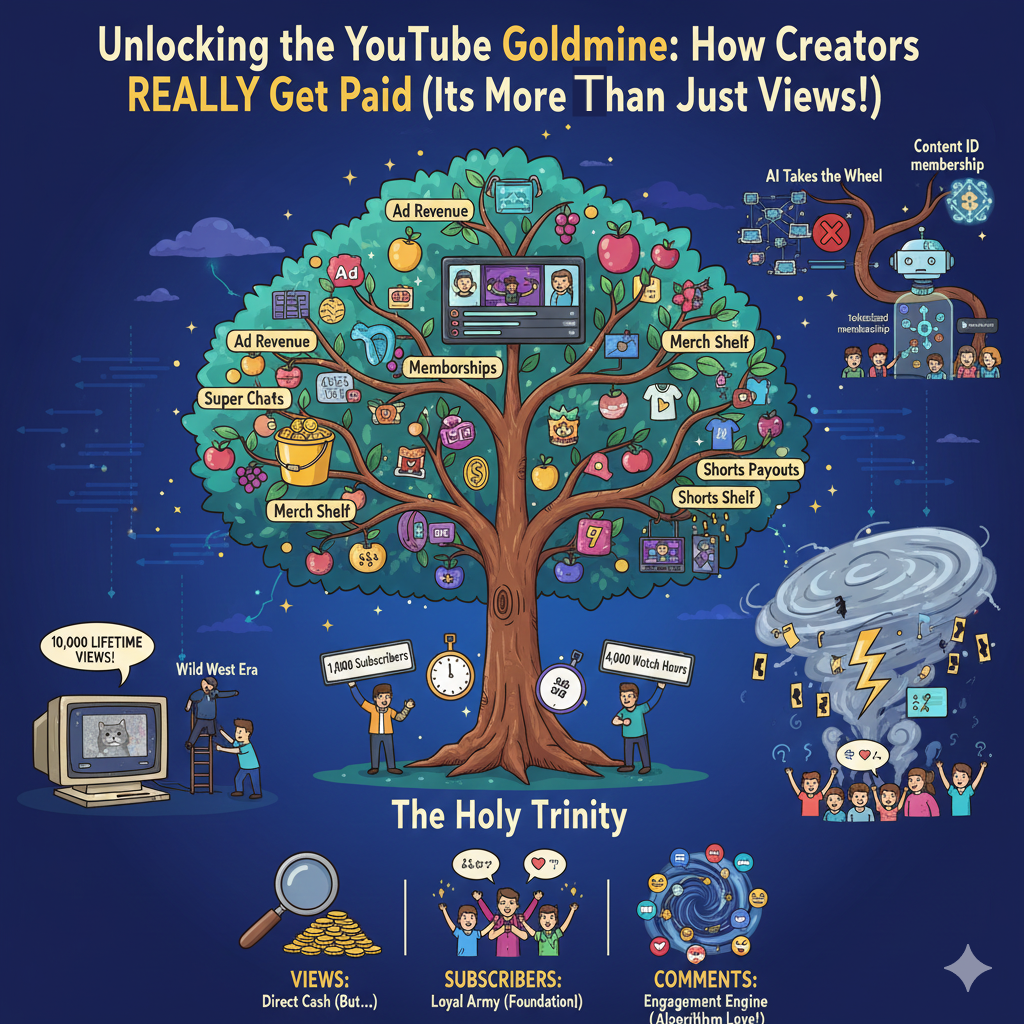
To truly comprehend the financial architecture of YouTube, one must first dismantle the misconception that it’s a monolithic structure. Far from it, the platform has cultivated what might be best described as a sprawling “money tree,” bearing various fruits beyond the immediate, familiar ad banners.
The OG Payout: Ad Revenue (The YouTube Partner Program)
At the very core, the foundational pillar of income for many creators is the YouTube Partner Program (YPP). This is the golden ticket, the primary conduit through which advertising revenue flows. The mechanism, in its simplest form, is elegantly straightforward: advertisements – be they pre-roll, mid-roll, or banner ads – pop up on eligible videos. Viewers either dutifully watch them or, perhaps with a touch of impatience, skip them. From this interaction, creators receive a slice of the advertising pie, a share of the revenue generated. And for those discerning viewers who opt for a YouTube Premium subscription, the contribution is no less significant; creators are compensated based on the watch time accrued from these premium subscribers, reflecting a more direct value exchange for their content.
Other Fruit on the Tree: Beyond the Ads!
But to fixate solely on ad revenue would be to miss the rich tapestry of opportunities YouTube has woven. The platform has thoughtfully diversified its offerings, allowing creators to cultivate additional, often more stable, income streams:
- Exclusive Clubs: Channel Memberships: Imagine a digital fan club, where devoted viewers pay a recurring monthly fee. In return, they gain access to exclusive perks: custom emojis, loyalty badges that stand out in comments, and sometimes even member-only content or live streams. It’s a direct, community-driven form of patronage.
- Live Stream Love: Super Chat & Super Stickers: During the ephemeral, often exhilarating, chaos of a live stream, viewers can make their presence known – and financially supported – through Super Chat and Super Stickers. These paid messages are highlighted, sometimes pinned to the top of the chat feed, ensuring the creator sees their support, while stickers add a playful, visual dimension.
- Merch Mania: The Merchandise Shelf: Capitalizing on the intrinsic brand-building nature of creators, YouTube integrated a “Merchandise Shelf” directly beneath videos. This seamless integration allows creators to sell official branded gear – T-shirts, mugs, hoodies – turning viewership into tangible fan loyalty and direct sales.
- Shop ‘Til You Drop: Affiliate Links & Product Promotions: A venerable strategy in the broader digital landscape, affiliate marketing finds a natural home on YouTube. Creators often include affiliate links in their video descriptions, earning a commission when viewers purchase products through those links. Beyond this, direct product promotions and brand sponsorships form another lucrative avenue, where creators are paid to integrate or feature products within their content.
- Short & Sweet Payouts: YouTube Shorts Ad Revenue: Even the bite-sized, vertically oriented world of YouTube Shorts has joined the monetization party. While the revenue share model differs and the per-view payout might appear smaller than its long-form counterparts, it nonetheless represents another significant branch on the money tree, acknowledging the immense reach and engagement Shorts now command.
The Gatekeepers
Before any of these fruits can be plucked, however, there are certain foundational requirements, “gatekeepers” if you will. To even begin monetizing, creators must satisfy specific criteria: a minimum of 1,000 subscribers, accumulated watch hours (typically 4,000 for long-form video or 10 million for Shorts), and, crucially, a steadfast adherence to YouTube’s community guidelines and monetization policies. These are not merely suggestions; they are the bedrock upon which a monetized channel is built.
A Walk Down Memory Lane: YouTube’s Evolving Pockets
To truly appreciate the current state of YouTube monetization is to understand its turbulent, yet fascinating, evolutionary journey. It’s a narrative punctuated by periods of unbridled optimism and moments of profound recalibration.
The Wild West Era (Early Days, 2007)
The true genesis of YouTube as a career platform began in 2007. Having been acquired by Google in 2006, the tech giant swiftly moved to integrate its advertising prowess. This ushered in the era of video ads and, most significantly, the launch of the YouTube Partner Program. In those nascent days, the barrier to entry was remarkably low, almost akin to a digital gold rush. Rumor, and indeed early creator accounts, suggest that one merely needed around 10,000 lifetime views to qualify for monetization. It was an era of experimentation, rapid growth, and, to some extent, a beautiful, untamed chaos where anyone with a camera and an idea could potentially strike digital gold.
The “Adpocalypse” & Growing Pains (2017)
This idyllic period, however, was not destined to last indefinitely. A seismic shift occurred in 2017, an event now infamously known as the “Adpocalypse.” A confluence of factors led to this crisis, primarily the discovery by major advertisers that their brands were appearing alongside highly controversial, offensive, or otherwise unsuitable content. The resulting backlash was swift and severe; advertisers, spooked by the potential damage to their brand image, began to pull their campaigns en masse.
YouTube’s reaction was equally dramatic and, for many creators, a painful necessity. The platform initiated a major crackdown, implementing far stricter content policies and, crucially, raising the eligibility thresholds for the YPP. The previous lax requirements were replaced with a more stringent set: a minimum of 1,000 subscribers and 4,000 valid public watch hours within the past 12 months. This marked a profound turning point, signaling YouTube’s commitment to creating a “safer,” more brand-friendly environment, albeit at the cost of significantly higher hurdles for aspiring creators. It was a clear demonstration of the platform’s commercial imperative overriding, to some extent, its initial ethos of unfettered access.
The Creator Crucible: Current Rants, Raves, and Real Talk
In the dynamic arena of YouTube, life for creators is a fascinating dichotomy of elation and exasperation. One might examine this current state as a crucible, where the fires of creativity meet the pressures of platform mechanics.
The Good Vibes
On the brighter side, there’s widespread appreciation for the very existence of a diversified creator economy that YouTube has fostered. The availability of multiple income streams – from ads to memberships, merchandise, and Super Chat – has provided creators with a degree of financial resilience that was unimaginable in earlier digital eras. This multi-pronged approach allows for greater stability, reducing the existential dread tied solely to volatile ad revenues.
The Grumbles & Headaches
Yet, the idyllic image is frequently marred by persistent frustrations and genuine anxieties that often plague the creator community:
- The “Black Box” Problem: A recurring lament among creators is the perceived lack of transparency and consistency in YouTube’s policy enforcement. Videos are often demonetized without clear, specific explanations, leaving creators asking, “Why was my video demonetized?” This opaqueness can feel arbitrary and profoundly frustrating, akin to navigating a complex machine with no visible gears or levers.
- Adpocalypse Jitters (Still!): The specter of 2017 continues to cast a long shadow. Creators remain acutely aware of their precarious position, perpetually worrying about the next significant policy shift or advertiser revolt that could, once again, dramatically impact their livelihood. This lingering anxiety underscores the inherent vulnerability of relying on a third-party platform for income.
- Copyright Catch-22 (Content ID): YouTube’s automated Content ID system, while designed to protect intellectual property, frequently becomes a nightmarish labyrinth for creators. It often flags content that creators firmly believe falls under “fair use,” leading to unwarranted strikes, demonetization, and lengthy, often frustrating, appeal processes. This friction highlights the imperfect nature of automated enforcement in nuanced legal areas.
- The Originality Police: A burgeoning concern is the platform’s increasingly stringent stance against “mass-produced” or “repetitious” content. This policy, designed to promote high-quality original work, has raised alarms among creators utilizing AI-assisted tools for content generation or those who repurpose and re-edit existing material, even with significant transformation. It’s a subtle but significant push towards valuing unique, human-centric creation.
- Shorts Payout Blues: While YouTube Shorts offers an incredible avenue for audience growth and reach, the per-view payout for this format is often significantly lower than that for long-form content. This discrepancy means that enormous view counts on Shorts may not translate into proportional financial returns, leading to a sense of imbalance for creators investing time and effort into this popular format.
Peeking into the Crystal Ball: YouTube’s Money-Making Future
What does the future hold for this dynamic platform and its legion of creators? Glimpsing into YouTube’s crystal ball reveals an exciting, if somewhat speculative, landscape, heavily influenced by technological advancements and evolving economic models.
AI Takes the Wheel (For Better or Worse?)
It’s evident that YouTube is investing heavily in artificial intelligence. We can anticipate AI playing an even more pervasive role in revenue generation: from dynamically inserting ads based on viewer context and content segments, to AI-powered shopping tools seamlessly integrated into videos, and even AI-assisted video creation tools designed to streamline the production process. The aim, undoubtedly, is to optimize and automate monetization at every possible juncture.
New Ad Adventures
The evolution of advertising on YouTube is a constant. We might expect to see an exploration of less intrusive ad formats, perhaps side-panel ads that run concurrently with live streams, or more contextually integrated product placements that feel less disruptive. Furthermore, there’s a discernible ambition to achieve higher ad revenue shares for exceptionally viral content, incentivizing creators to produce highly engaging, widely shareable material.
Beyond Ads: Building Your Own Kingdom
A significant trend points towards empowering creators to build more direct and stable financial relationships with their audience. This means an even greater emphasis on subscriptions and direct fan support mechanisms like memberships and Super Chat. The platform appears to be fostering an environment where creators can cultivate their own “kingdoms,” less reliant on the vagaries of the advertising market. And, stepping into the realm of speculation, one might even ponder the advent of Web3-inspired features, such as “tokenized memberships” for super-fans, offering exclusive access or voting rights, thereby fostering deeper, blockchain-backed engagement.
The Quality Crusade
Finally, expect a continued, perhaps intensified, push for original, high-quality, value-added content. The days of quick cash grabs through repetitive or low-effort content appear to be numbered. YouTube’s strategic imperative is to elevate the overall quality of its content library, ensuring a richer, more engaging experience for viewers and, by extension, a more attractive environment for advertisers and direct fan support alike.
The Holy Trinity: Views, Subscribers, & Comments – How They REALLY Add Up!
One might be tempted to simplify YouTube’s monetization to a single metric: views. Yet, such a reductionist view misses the profound, interconnected dynamic between views, subscribers, and comments – a veritable holy trinity that, when working in concert, truly dictates a creator’s success.
Views: The Direct Cash Cow (But There’s a Catch!)
Yes, fundamentally, more views do equate to more ad money. This is the most straightforward and intuitive link. More eyeballs on a video naturally lead to more ad impressions, and thus, more revenue for the creator. However, this is where nuance becomes paramount. It’s not just about raw view counts. A multitude of factors intricately weave together to determine the actual earnings:
- Audience Retention: How long do people actually watch your video? A video with high retention is valued more by YouTube and advertisers.
- Ad Types & Formats: The kind of ads displayed (skippable vs. non-skippable, display vs. overlay) and their prevalence significantly impact revenue.
- Viewer Demographics: The geographical location and demographic profile of your audience can influence ad rates, as advertisers often target specific groups.
- Niche & Content Category: Certain niches (e.g., finance, tech) often command higher ad rates than others due to advertiser demand.
Therefore, while a rough estimate might place earnings anywhere from $0.01 to $0.03 per view, translating to perhaps $10 to $30 for every 1,000 views, it’s a highly variable equation. A creator shouldn’t merely chase views; they must chase quality views that sustain engagement.
Subscribers: Your Loyal Army (The Foundation!)
Subscribers are the bedrock, the loyal army upon which a successful channel is built. It’s a crucial distinction: YouTube doesn’t directly pay you a single cent per subscriber. However, their value is essential and manifold:
- YPP Eligibility: First and foremost, the 1,000 subscriber minimum is a non-negotiable prerequisite for even starting to monetize through the YouTube Partner Program. No subscribers, no ad revenue.
- Built-in Audience & Initial Boost: Subscribers are your most ardent and reliable viewers. They receive notifications of new uploads, populate your initial view counts, and provide that crucial early engagement that signals to the algorithm that your content is worth watching.
- Community & Other Revenue: Subscribers are the prime candidates for converting into paying channel members, contributing via Super Chat, or purchasing merchandise. They represent a deeply engaged community, far more likely to financially support a creator they trust and enjoy.
Comments: The Engagement Engine (The Algorithm’s Love Language!)
Just as with subscribers, YouTube does not, contrary to popular myth, pay creators per comment. Yet, comments are pure gold, a vital cog in the algorithm’s intricate machinery.
- Algorithm Love: Comments, alongside likes, shares, and watch time, are powerful signals to YouTube’s algorithm that your video is generating significant engagement and value. The algorithm, in its perpetual quest to keep viewers on the platform, interprets high engagement as a marker of compelling content.
- The Virtuous Cycle: More engagement often leads to YouTube recommending your video to a broader audience, which in turn leads to more views, and ultimately, more ad revenue. It’s a self-reinforcing, virtuous cycle where interaction fuels reach.
- Community Builder: Comments foster a profound sense of connection and community. They allow viewers to interact with the creator and with each other, transforming passive consumption into active participation. This sense of belonging makes viewers far more likely to return, subscribe, and become loyal, long-term fans.
- Free Content Ideas: Perhaps one of the most underrated benefits: your audience, through their comments, often tells you exactly what they want to see next. This direct feedback loop is an invaluable source of content ideas, ensuring creators remain attuned to their community’s desires.
Conclusion: The Ever-Evolving Art of the YouTube Grind
To distill it to its essence, YouTube monetization is a complex, dynamic beast, far more intricate than the simplistic notion of “more views equals more money.” It is an art form, demanding not only creative talent but also a strategic understanding of the platform’s mechanics, a dedication to community building, a nuanced appreciation for the algorithm’s whims, and an astute approach to diversifying income streams.
It is undoubtedly a challenging world for creators, fraught with policy shifts, technological advancements, and the constant pressure to innovate. Yet, it is also an incredibly rewarding one, a testament to the power of digital platforms in fostering entirely new economies and career paths. So, the next time you find yourself immersed in a captivating YouTube video, take a moment to remember the intricate, multi-layered ecosystem that hums quietly behind that unassuming “Like” button. It’s a testament to human ingenuity, algorithmic complexity, and the relentless evolution of our digital age.