Red Light, Green Light, Smart Light: The Epic Evolution of Our Roadside Heroes
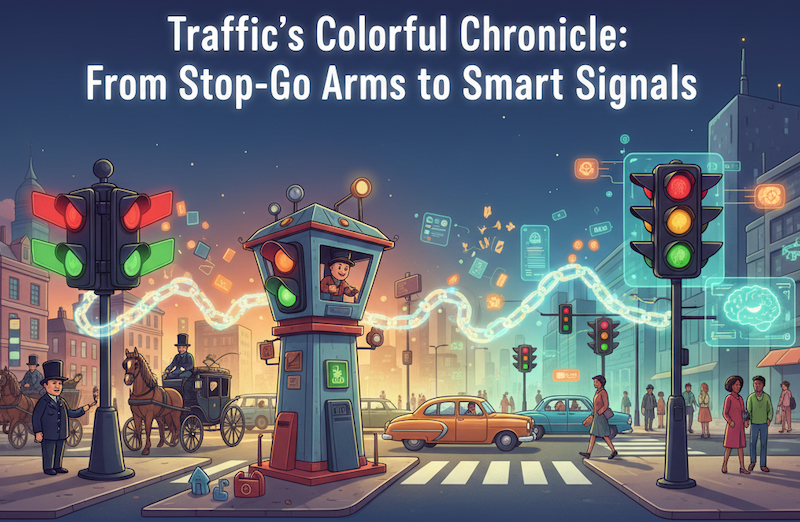
1. Intro: More Than Just a Pretty Face (or a Red/Green One!)
Ever cursed a persistent red light that seems to defy logic, or sighed with profound relief at the welcoming glow of a green? These ubiquitous sentinels of our urban landscape, often relegated to the background hum of daily commutes, are so much more than mere colored lamps. We ignore them at our peril, yet rarely do we consider them beyond their immediate command. But what if I told you that behind their mundane exterior lies a surprisingly wild, indeed almost dramatic, tale of human ingenuity and ceaseless adaptation?
They are, in essence, the unsung heroes orchestrating the daily chaos of millions, silently managing the ebb and flow of vehicles and pedestrians. And, oh, how they have transformed! From rudimentary, rather dangerous, gas-powered contraptions to today’s hyper-intelligent, mind-reading AI systems, their journey is a fascinating microcosm of technological progress. Join me, if you will, on a brief intellectual foray into their humble, fiery beginnings, their surprisingly sophisticated present, the persistent grumbles they evoke, and their rather astonishing, sci-fi future. It’s a journey well worth taking.
2. Chapter 1: The OG Stop-and-Go – A Fiery Start (History Lesson, but make it fun!)
To truly appreciate our contemporary traffic light, one must first cast their mind back to an era of delightful pandemonium. Before the automobile, imagine the horse-drawn carriages, the drays, the hansom cabs, and countless pedestrians all vying for the same sliver of road. It was, one might surmise, an absolute mayhem that practically begged for order.
And so, it was in this very crucible of urban chaos that the world’s first attempt at traffic control emerged in 1868, outside the Houses of Parliament in London. Enter J.P. Knight, a railway signal engineer who, with a rather ingenious transfer of technology, proposed a system. His setup involved semaphore arms – much like those used on the railways – manually operated by a lone police officer, augmented by red and green gas lamps for nighttime visibility. Sounds rather sophisticated for the era, does it not? Yet, in a testament to the early trials of innovation, this pioneering spirit met an unfortunate, if rather explosive, end. A gas leak led to an explosion, injuring the officer and, perhaps understandably, sending the concept back to the drawing board for a spell.
The turn of the 20th century, however, brought a new, far more formidable challenge: the automobile. Cars arrived, and with them, the chaos multiplied exponentially, imbuing the quest for traffic control with a new, urgent imperative. This led to the pivotal Cleveland breakthrough of 1914, where Lester Wire introduced the first electric red/green signal. Safer, brighter, and certainly less prone to fiery mishaps, it was a significant step. But it was in Detroit, 1920, that William Potts added the crucial yellow warning light – that fleeting moment of amber contemplation before the definite stop or go. Ta-da! The fundamental three-color system we largely recognize today was born. And let us not forget the visionary Garrett Morgan, who in 1923 patented his T-shaped signal, a design that further propelled the move towards automated control. One might also chuckle at Detroit’s earlier, rather noisy, experiment in 1928: signals that actually listened for car horns! Imagine the cacophony.
By the 1930s and 50s, these innovations had become mainstream, steadfastly taming traffic across the globe, transforming the anarchic street into a surprisingly predictable ballet.
3. Chapter 2: Today’s Tech Wizards – From Dumb Timer to Smarty Pants
The intervening decades have seen our roadside heroes undergo a quiet, yet profound, transformation. No longer are they mere automatons of predetermined time cycles; today’s traffic lights are evolving into sophisticated, adaptive entities.
First, the visual metamorphosis: gone are the incandescent headaches, those power-hungry bulbs prone to burning out. Hello, LED! Super bright, incredibly durable, and sipping energy with a commendable frugality, LEDs have revolutionized the basic display.
But the true magic lies beneath the surface, where our lights have grown “eyes and ears” on the road, thanks to a dazzling array of sensors. Remember that moment of existential dread when you pull up to an empty intersection and the light just won’t change? That’s where induction loops come in – those invisible coils embedded in the road, silently detecting the presence of vehicles. More advanced systems deploy radar and laser sensors from above, gauging speed and distance. Perhaps the most profound shift, however, comes with AI-powered cameras. These aren’t just recording; they’re analyzing – calculating traffic volume, assessing speed, identifying congestion patterns, and even distinguishing between vehicles, pedestrians, and cyclists. They are, in essence, becoming traffic detectives, processing real-time data to paint an intricate picture of the roadway.
And what good are eyes and ears without a brain? This data feeds into adaptive algorithms – the true brains of the operation. No longer are we shackled by rigid, fixed timers that make us wait unnecessarily at empty intersections. These intelligent systems react in real-time: granting longer greens to heavily trafficked roads, offering VIP treatment to emergency vehicles, or extending pedestrian crossing times for those who need a few extra precious seconds. The overarching goal is a symphony of efficiency: less waiting, less honking, less wasted fuel, and a smoother flow for all.
4. Chapter 3: The Grumbles and Gripes – When Smart Lights Aren’t So Smart
Despite this impressive evolution, the journey towards perfect traffic orchestration is, of course, fraught with human (and mechanical) imperfections. Even in our quest for ideal order, friction persists, and the age-old complaints echo through the asphalt.
The perennial “Why Am I Waiting?!” remains arguably the most potent grievance. It’s a curious paradox that even with sophisticated sensors, many systems remain stuck in the past or are simply not optimally maintained. This leads to those interminable waits, the kind that waste fuel, fray nerves, and ignite pure driver rage. The theoretical promise of intelligence often clashes with the practical reality of implementation and oversight.
Then there are the accidental oopsies. Sometimes, an overabundance of lights or poorly synchronized ones can, ironically, cause accidents – think of those frustrating rear-enders born of abrupt stops. This raises a legitimate debate: for low-traffic areas, is simpler sometimes better? Does the classic stop sign, with its clear, universal command, offer a more elegant solution than a complex, potentially mismanaged light?
The “rat run” effect is another testament to human ingenuity (or frustration). Annoyed drivers, seeking to circumvent persistent delays, often bail out onto quieter residential streets, inadvertently creating new problems and disrupting the peace of previously tranquil neighborhoods. And let us not forget the pedestrian peril: long, frustrating waits or confusing signals inevitably lead to jaywalking, transforming a moment of impatience into a dangerous gamble.
5. Chapter 4: The Road Ahead – Sci-Fi Intersections and White Lights!
But let us not dwell too long on the present’s imperfections, for the future of traffic management is nothing short of extraordinary. We stand at the precipice of developments that will redefine our relationship with these roadside heroes.
My crystal ball suggests even more profound applications of AI. Beyond merely reacting to current conditions, future lights will predict traffic jams before they even fully manifest, proactively adjusting cycles based on a symphony of data: weather forecasts, upcoming events, historical patterns. Imagine a system that anticipates rush hour congestion an hour in advance and subtly shifts timing to mitigate it before it cripples the city. Mind. Blown.
The true game-changer, however, will be Vehicle-to-Infrastructure (V2I) communication. Your car, particularly autonomous vehicles, will literally “chat” with the traffic light: “Hey, I’m approaching at this speed, with this many passengers, heading this way, clear the path!” This real-time dialogue could lead to an almost balletic flow, where convoys of vehicles seamlessly glide through a series of green lights, eliminating the infuriating stop-start of conventional driving.
And then, there’s the truly radical notion: The Mysterious White Phase. Imagine a fourth color! Not red, yellow, or green, but white. What could it possibly signify? The idea is elegantly simple: in a world increasingly populated by autonomous vehicles, the white light would indicate, “Human drivers, please chill out! The autonomous cars are taking the lead here. Simply follow the self-driving vehicle directly in front of you.” It’s a fascinating concept designed to maximize efficiency and safety in a mixed human/robot driving environment, allowing the AI to optimize flow and humans to simply conform.
Beyond the vehicular ballet, these future systems promise to make roads safer for everyone, with even smarter detection and prioritization for walkers and cyclists. Environmentally, the glow will be even more eco-friendly, perhaps with solar-powered lights becoming the norm. Ultimately, we envision integrated city brains – traffic lights not just talking to cars, but to buses, emergency services, smart parking systems, and indeed, the entire “smart city” network. It’s not just a traffic light anymore; it’s a node in a vast, interconnected urban consciousness.
6. Conclusion: From Gas to Genius – The Future is Bright (and Green!)
So, there we have it. From a clumsy, somewhat explosive gas lamp in Victorian London to today’s brainy, sensor-laden intersections, and tomorrow’s speculative, sci-fi dreams of V2I communication and even a “white phase,” traffic lights have indeed come an astonishingly long way.
These often-overlooked “unsung heroes” are about to get even smarter, safer, and undeniably more indispensable as our cities continue their inexorable evolution. They are no longer just arbiters of right-of-way; they are becoming intelligent orchestrators of urban mobility, promising a future of smoother commutes, reduced congestion, and enhanced safety for all. The journey, one might confidently assert, continues, and its future is undeniably bright – and, we hope, predominantly green.