Untangling Your Network: Routers, Switches, and Why You Should Care!
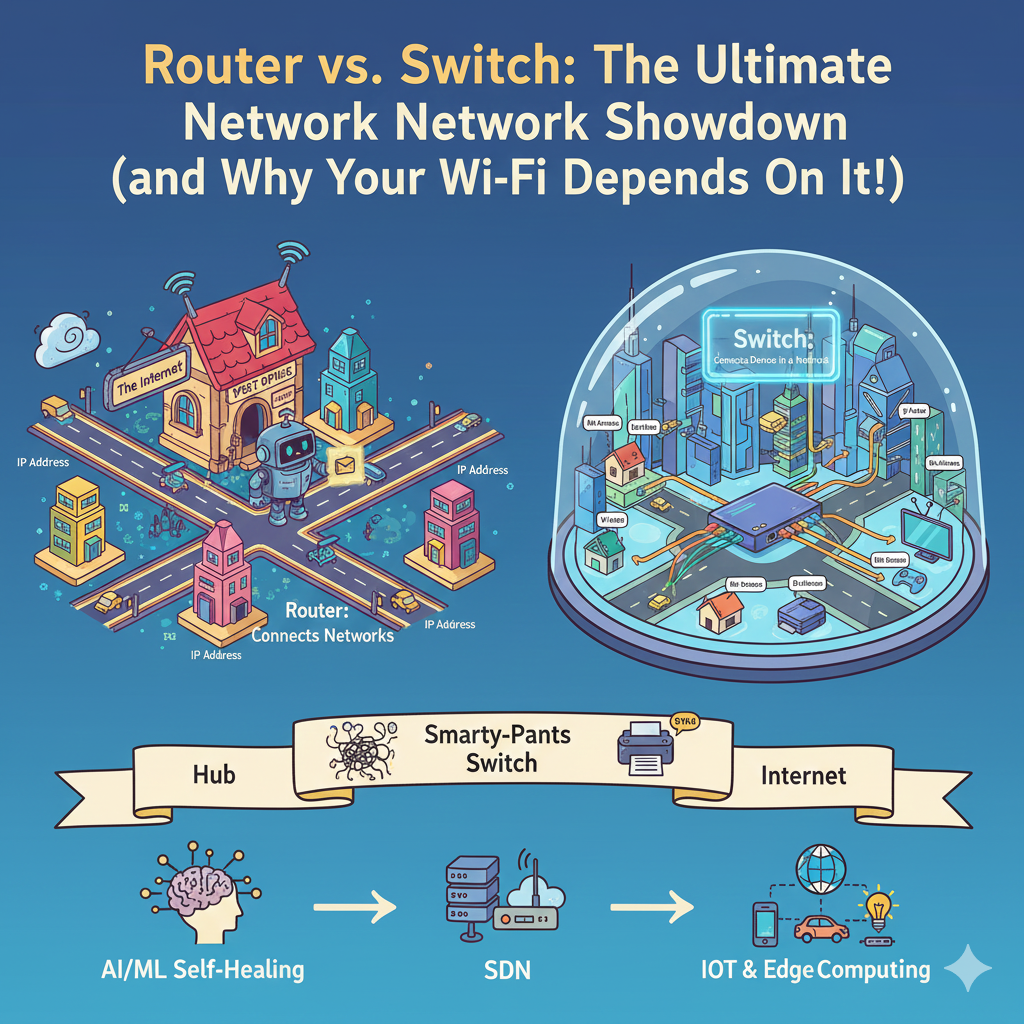
Ever stared blankly at those blinking boxes in your office or beneath your desk, wondering why your internet sometimes stutters or what arcane magic they perform? You’re not alone in this digital bewilderment. In our hyper-connected world, we often take the seamless flow of information for granted, rarely pausing to consider the silent, tireless work of the devices that make it all possible. Today, let’s pull back the curtain on two such unsung heroes: the router and the switch – the dynamic duo behind virtually every digital interaction you have.
We hear these terms, “router” and “switch,” thrown around with a certain casualness, often interchangeably in everyday conversation. But what’s the actual, fundamental difference? And, more importantly, why on earth should you, the everyday user or even the budding tech enthusiast, truly care? Fear not, for we’re about to embark on a journey. We’ll break down these network ninjas, peer into their historical genesis, dissect their quirks and capabilities, and even gaze into their technological future. All this, I promise, without requiring a computer science degree or drowning you in jargon. Consider this a musing, an intellectual stroll through the very fabric of our digital existence.
Meet the Dynamic Duo: Router vs. Switch – Who Does What?
Let’s try a simple analogy to disentangle these two, for clarity is paramount when examining the foundational elements of our digital world.
-
The Router: Your Digital Post Office! Imagine your router as the sophisticated, perhaps slightly grumpy, post office that connects your cozy little home (or office) network to the vast, wild world of the internet. Its primary, existential purpose is to connect different networks. It’s the digital ambassador, speaking multiple networking languages to ensure your data packets, much like letters with specific postal codes, find their way across vast distances – from your browser to a server halfway across the globe, and back again. It meticulously reads IP addresses (think of them as unique geographic coordinates or postal codes for entire networks) to chart the most efficient course for your data, making decisions about which digital highway your information should travel. Without a router, your private network would be an island, utterly cut off from the global conversation. It’s about getting mail between cities, regions, even continents.
-
The Switch: The Ultra-Efficient Internal Traffic Cop! Now, think of the switch as the hyper-organized, incredibly efficient internal traffic cop, or perhaps the diligent head librarian, managing all the traffic within a single, well-defined network. Its job is to connect multiple devices within that one network. Your desktop PC, your smart TV, your network printer, your gaming console – all these gadgets might be chatting amongst themselves, and the switch is the master orchestrator of that local dialogue. Unlike the router, it doesn’t care about the outside world. Instead, it learns the MAC addresses (Media Access Control addresses – unique hardware identifiers, akin to a specific street address within a city) of every device connected to it. When your computer sends data to your printer, the switch doesn’t broadcast that message to every device on your network (like a town crier yelling to everyone); it intelligently directs the data frame only to the printer. This precision ensures optimal performance, minimizes unnecessary network chatter, and maintains a clean, quiet internal communication environment. It’s about directing traffic within one city or building, making sure every car reaches its precise destination without causing a traffic jam.
So, when do you call upon which one? The decision, in retrospect, is quite logical:
- Need more internet connections (Wi-Fi/Ethernet) and to bridge your private network to the vast expanse of the outside world? You absolutely, unequivocally need a Router.
- Have sufficient internet access but require more wired ports for devices within your existing home or office network? Grab a Switch! This is particularly pertinent if your router, a typical home model, offers only four wired ports, but you find yourself with eight wired gadgets vying for a connection.
And here’s a quick, vital note: Most “wireless routers” you purchase for home use are, in fact, incredibly versatile, super-combo devices. They elegantly package a router, a multi-port switch, AND a Wi-Fi access point, all in one neat, often unassuming, box. A testament to engineering convergence, simplifying our digital lives while subtly obscuring the underlying complexity.
A Walk Down Network Lane: From Chaos to Cleverness (The History Bit!)
To truly appreciate these devices, a brief intellectual detour into their past is instructive. The evolution of networking is a fascinating tale of problem-solving and efficiency.
In the Wild West of Networking (70s-80s), connecting computers was a far simpler, albeit cruder, affair. Remember those old “hubs”? They were the predecessors to switches, but with a significant flaw. A hub was akin to someone shouting every message to everyone in a crowded room. If your computer sent data to another, every single device connected to the hub received that data, whether it was the intended recipient or not. This created an incredibly inefficient, “noisy” network rife with “collisions” where data packets literally bumped into each other, requiring retransmission. It was, in essence, digital chaos.
Then, in the 80s, Enter the Smarty-Pants Switch. Someone brilliant, often credited to minds at DEC (Digital Equipment Corporation), had a eureka moment: “Hey, what if we only sent messages to the right person?” This seemingly simple insight revolutionized local area networking. The first switches, unlike their hub predecessors, learned the MAC addresses of connected devices, effectively creating a dedicated, virtual pathway between two communicating devices. No more shouting, no more collisions, just direct, efficient communication. And just like that, internal networks became exponentially smoother and faster.
As this internal network efficiency was being perfected, another, grander phenomenon was unfolding: The Internet Explodes, and Routers Reign (80s-90s). As ARPANET evolved into the nascent internet, transforming from a small academic and military network into the global beast we recognize today, the need for devices to intelligently guide data across vast, disparate networks became paramount. Routers, with pioneers like Cisco Systems leading the charge, emerged as the internet’s essential pathfinders. They were the architects of inter-network communication, ensuring data could traverse oceans, continents, and countless smaller networks, making the global web a navigable reality.
Today, as observed earlier with our home “wireless routers,” these technologies have beautifully blurred their lines. This blurring of lines is not just a convenience; it’s a profound engineering achievement that delivers integrated, powerful networking solutions, making our digital lives simultaneously easier and less cluttered.
The Brains of the Operation: Managed vs. Unmanaged Switches – Do You Need a Smarty-Pants Switch?
While all switches direct traffic, not all switches are created equal. This distinction is crucial for anyone pondering more control over their network.
-
The “Plug & Play” Pal: Unmanaged Switches Think of an unmanaged switch as the basic, no-frills economy car. It gets you from point A to point B, reliably and without fuss.
- Pros: They are dirt cheap, super easy to use (literally just plug them in, and they work!), and perfectly sufficient for basic home networks or simply expanding the number of wired ports available. No configuration, no software, no decisions.
- Cons: What you see is what you get. There’s no control, no fancy features, and you can’t tweak anything. They operate solely on their factory-set logic.
-
The “Control Freak’s” Dream: Managed Switches Now, imagine a high-performance sports car: sleek, powerful, and packed with customizable settings, advanced diagnostics, and precision control. That’s a managed switch.
- Pros: This is where networking gets interesting for the enthusiast or the enterprise.
- VLANs (Virtual Local Area Networks): This feature allows you to segment your physical network into separate, isolated logical networks. You could create a secure network for your work devices, a separate one for guest Wi-Fi, and another for your IoT gadgets, enhancing both security and performance by reducing broadcast traffic.
- QoS (Quality of Service): Ever had your video call pixelate because someone else started a massive download? QoS lets you prioritize certain types of traffic. You can ensure your real-time applications (voice, video) get preferential treatment over less time-sensitive data transfers.
- Security Features: Managed switches offer robust security, allowing you to lock down specific ports, control who accesses what, and even implement advanced authentication protocols.
- Monitoring & Troubleshooting: They provide deep insights into network traffic, allowing you to see what’s happening, diagnose bottlenecks, and troubleshoot problems effectively.
- Scalability: Absolutely essential for growing businesses or complex home labs, allowing for modular expansion and intricate network design.
- Cons: They are undeniably more expensive and require a certain degree of technical know-how to configure and manage. For grandma’s house, they’re likely overkill, introducing unnecessary complexity.
- Pros: This is where networking gets interesting for the enthusiast or the enterprise.
Current Opinion: For the casual home user or a small, straightforward setup, an unmanaged switch is a perfectly pragmatic choice. For businesses, dedicated tech enthusiasts, or anyone seeking granular control, enhanced security, and optimized performance, a managed switch offers unparalleled capabilities and insights into their digital domain. It’s a choice between simple utility and sophisticated mastery.
The Dark Side of the Network: When Things Go Wrong (Controversies & Concerns)
Our network heroes, despite their silent efficiency, are not without their vulnerabilities and controversies. Examining these “darker” aspects is part of a holistic intellectual inquiry.
-
Who Made That Router?! Supply Chain Shenanigans: We’ve all seen the headlines. Accusations against certain hardware manufacturers – often state-backed – of embedding “backdoors” or undisclosed vulnerabilities into their devices. For governments, critical infrastructure, and businesses handling sensitive data, the provenance and integrity of networking hardware are paramount. Trust, in this realm, isn’t just a virtue; it’s a foundational security requirement, and its erosion has significant geopolitical ramifications. The opaque nature of global supply chains adds layers of complexity to this concern.
-
Outdated Software, Open Doors: This is a silent, insidious threat. Just like your smartphone or computer, the “firmware” (the embedded software) of your router and switch needs regular updating. Unfortunately, many users neglect this vital task, leaving their networks vulnerable to cunning attackers who exploit known, unpatched weaknesses. An outdated router is akin to leaving your digital front door wide open in a bustling city – an invitation to those with ill intent. The convenience of “set it and forget it” often comes with unseen risks.
-
The “Black Box” Blues: For the vast majority of us, these devices remain magical black boxes. Their internal workings and security implications are often obscured by technical complexity. This lack of transparency can lead to a reliance on default settings, which are frequently chosen for ease of setup rather than optimal security, thus inadvertently compromising our digital perimeters. Understanding their basic mechanisms becomes a matter of digital literacy.
-
Oops! Misconfiguration Mayhem: Managed switches, as we’ve discussed, are powerful tools. But with great power, as the adage goes, comes great responsibility – and the potential for epic screw-ups. One wrong setting, a misconfigured VLAN, or an improperly defined QoS policy can not only degrade network performance but also bring an entire network crashing down, creating security holes, or causing critical applications to fail. The human element, with its propensity for error, is a significant factor in network stability and security.
Peeking into the Future: What’s Next for Our Network Heroes?
The digital world is ceaselessly evolving, and with it, the very devices that underpin its functionality. Let’s cast our gaze forward and speculate on the future of routers and switches.
-
SDN: The Network’s New Brain: Imagine managing your entire network from one central, intelligent control panel, almost like something out of a sci-fi movie. Software-Defined Networking (SDN) is precisely that vision. It decouples the network’s control plane (the “brain”) from the data plane (the “muscle” that forwards packets). This paradigm shift makes networks smarter, far more flexible, and incredibly easier to automate. Less manual fiddling with individual devices, more digital wizardry orchestrated from a single point – enabling rapid deployment of services, dynamic traffic management, and unprecedented network agility.
-
Faster, Stronger, Better!: Our insatiable thirst for bandwidth shows no signs of abating. Expect to see even crazier speeds become commonplace. We’re already seeing 10 Gigabit Ethernet (10GbE) moving into prosumer and small business markets, and 100 Gigabit Ethernet (100GbE) and beyond are standard in data centers. These escalating bandwidths are essential to handle the explosion of high-definition streaming, immersive virtual reality, online gaming, and the sheer volume of data generated by an ever-growing array of connected devices.
-
IoT & Edge Computing: Smarter Devices Everywhere: With billions of IoT gadgets predicted to come online – from smart home appliances to industrial sensors – routers and switches will evolve to become even more intelligent. They will move closer to the “edge” of the network, performing more processing, filtering, and even rudimentary AI tasks locally, reducing latency and bandwidth strain on central clouds. They will become digital gatekeepers, securing and managing the colossal swarm of tiny, ubiquitous devices entering our networks.
-
Security Gets Even Smarter: Anticipate these devices transforming into sophisticated digital bodyguards. Future routers and switches won’t just block known threats; they will actively detect anomalous behavior, identify emerging attack patterns using advanced heuristics, and prevent intrusions proactively, often before a human even notices a potential problem. Integrated AI and machine learning will power these next-generation threat detection and response capabilities directly within the network hardware.
-
AI/ML: The Self-Healing Network: The ultimate vision for future networking is the “self-healing” network. Picture your infrastructure learning from its own performance, adapting to changing traffic patterns, predicting potential failures, and even fixing itself – rerouting traffic, reconfiguring parameters – often before you even perceive an issue. AI and Machine Learning are already starting to make networks “self-optimizing” and “self-healing,” promising unprecedented levels of resilience and efficiency.
Conclusion: You’re Now a Network Ninja!
So, we’ve journeyed through the intricate yet fascinating world of network infrastructure. You’ve uncovered the fundamental distinction between a router, the digital post office connecting disparate networks, and a switch, the efficient traffic cop managing internal communication within a single network. We’ve traced their historical path from chaotic beginnings to their current cleverness, delved into the strategic choice between managed and unmanaged switches, contemplated the very real controversies and security concerns they present, and dared to peek into their exhilarating future.
You’re no longer just plugging things in, blindly hoping for the best! You now possess an informed understanding of the basic architecture that underpins your entire digital life. This knowledge is not merely academic; it empowers you to make smarter choices for your home or business network, diagnose problems with greater insight, and even demand higher standards of security and performance.
The digital world is a constantly evolving tapestry, and its unsung heroes – our routers and switches – are at the very heart of that dynamism. Keeping an eye on these developments means equipping ourselves for a faster, safer, and more profoundly connected future for us all. Go forth, discerning network ninja!