Why Your PC's Brains Are Costing a Fortune – And When Your Wallet Can Breathe Again
You’ve been there, haven’t you? That moment of quiet contemplation, perhaps planning a new rig, or merely considering a crucial upgrade for your aging workstation. You navigate to your preferred online retailer, click on the memory section, and then… gasp. A sharp intake of breath as the numbers flash across your screen. “Wait, that much for RAM?!” It’s not just a momentary glitch in your browser; it’s a stark, undeniable reality.
Indeed, the price of memory, particularly for the ubiquitous consumer-grade DDR4 and DDR5 modules, has ascended to rather dizzying heights. This isn’t merely a minor market fluctuation; it’s a full-blown economic phenomenon. What we are witnessing is a classic tale of supply struggling desperately to meet a voracious, unprecedented demand. But to simply label it as such would be an oversimplification, a superficial glance at a much deeper structural shift. We are, it seems, at an inflection point.
So, let us embark on a journey, peeling back the layers of this burgeoning crisis. We shall dissect the ‘why,’ peer into the shadowy corners of global semiconductor fabrication, and, perhaps most importantly, ponder if there’s any glimmer of light at the end of this increasingly expensive tunnel. Spoiler alert: prepare yourself; the forecast isn’t exactly brimming with immediate sunshine.
A Nostalgic Trip Down Memory Lane
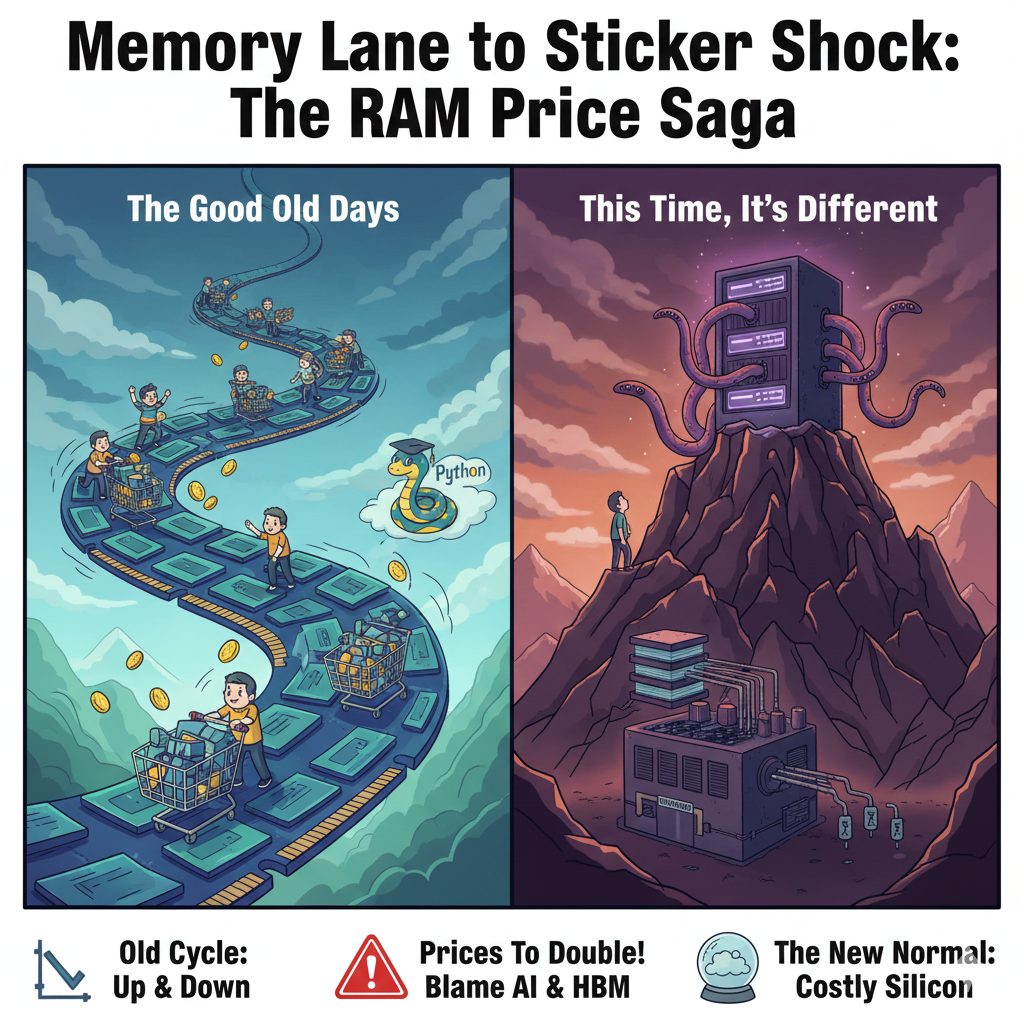
For those of us who have followed the ebb and flow of PC hardware pricing over the decades, the memory market was once a rather predictable, if sometimes volatile, beast. It was a veritable roller coaster, certainly – prices would climb, then plummet as manufacturers overproduced, then gradually recover as demand caught up. Consumers, ever vigilant, learned to time their purchases, occasionally basking in the glory of dirt-cheap upgrades. It was a cyclical dance, a rhythmic interplay of supply, demand, and manufacturing capacity that, in its own way, offered a comforting sense of order.
But one must disabuse oneself of that nostalgic comfort. What transpires today is not merely another peak or trough in the familiar cycle. This is different. Fundamentally different. The very rules of the game appear to have been rewritten, the chessboard dramatically rearranged. This isn’t just a temporary blip; it signals a profound, almost tectonic shift in the industry’s priorities and economic architecture.
The Plot Twist: What’s Driving the Madness?
So, if it’s not the old song and dance, what insidious forces are at play? The answer, as it turns out, is a fascinating interplay of technological evolution, insatiable demand, and naked economic incentive.
The AI Overlord: Meet Your Primary Culprit!
If one were to point a finger at a single, overarching catalyst for this dramatic shift, it would undoubtedly be the ascendance of Artificial Intelligence. The AI boom isn’t just about the charmingly verbose chatbots or the mesmerizing image generators that populate our digital feeds. No, this is about something far more fundamental, far more infrastructure-heavy. We’re talking about massive, sprawling data centers, gorging themselves on computational power, housing thousands upon thousands of GPUs, all demanding mountains – veritable Everest ranges – of high-speed memory. Think supercomputers on steroids, constantly training and refining ever-larger models. Their hunger is insatiable.
And what feeds this digital behemoth? Not your garden-variety DDR4. The true gold, the specialized elixir for these AI accelerators, is High Bandwidth Memory (HBM). This isn’t just faster RAM; it’s a radically different, vertically stacked memory technology designed for extreme bandwidth, perfectly suited to the parallel processing demands of AI. And crucially, for manufacturers, HBM is a high-margin product, a lucrative frontier.
Picture, if you will, the factory floor. Where once the automated lines hummed, churning out legions of DDR4 and DDR5 modules for your gaming rig or office PC, those same machines are now being rapidly retooled. The pivot is undeniable, the economic calculus stark: why produce lower-margin consumer memory when the AI industry is begging, almost pleading, for high-margin HBM? Your regular RAM, in this grand scheme, has unfortunately become an afterthought, almost an inconvenience.
The Generational Gauntlet: DDR4’s Farewell & DDR5’s Pricey Hello
Adding another layer of complexity to this already tangled web is the ongoing generational transition in memory standards.
DDR4’s Last Hurrah: The production lines for the venerable DDR4 standard are, quite naturally, winding down. As the sun sets on this era, less supply enters the market. Yet, demand persists, fueled by older systems needing upgrades or budget-conscious builders seeking a cheaper path. Less supply plus continued demand, as any economist will tell you, equals higher prices. It’s the inevitable fate of an outgoing standard, exacerbated by current market dynamics.
DDR5’s Premium Entry: Then we have DDR5, the new kid on the block. It’s faster, yes, boasting increased bandwidth and efficiency. But it’s also inherently more complex to manufacture, requiring tighter tolerances and more sophisticated power management on the module itself. This complexity translates directly into higher production costs. As the industry inexorably shifts towards this new standard, compelling us all to transition, we are not just buying into faster performance; we are buying into a fundamentally more expensive future for system memory.
The Whispers of Discontent: Is This Fair?
Given these circumstances, it’s hardly surprising that murmurs of discontent, bordering on suspicion, have begun to ripple through the enthusiast communities and beyond.
“Deliberate Shortage” Suspicions
While one hesitates to invoke the specter of outright conspiracy, it’s difficult not to raise an eyebrow. Are manufacturers merely responding rationally to overwhelming market forces, pivoting their resources to where the highest profits reside? Or are they, consciously or unconsciously, perhaps even intentionally, constraining the supply of consumer RAM to further incentivize the lucrative, high-margin AI segment? The optics, one must admit, suggest a strong prioritization of profits over the needs of the mainstream PC builder. It’s an economic calculus that leaves many feeling like collateral damage.
The Two-Tiered Memory Future
This brings us to a more unsettling prospect: the potential emergence of a two-tiered memory future. Imagine a world where the AI sector, with its deep pockets and seemingly limitless demand, receives preferential treatment for all cutting-edge, plentiful memory, while standard consumer RAM becomes increasingly scarce, a luxury item, almost an afterthought. Are we, the humble users of personal computers, simply secondary considerations in the grand AI gold rush, relegated to scavenging for scraps of what was once an abundant resource? It’s a speculative thought, perhaps, but one that gains traction as prices continue their relentless climb.
The Crystal Ball: When Can Our Wallets Breathe Again?
One naturally yearns for a silver lining, a forecast of impending relief. Alas, the crystal ball, for the moment, remains rather clouded, casting a long shadow.
Brace Yourselves: More Pain Ahead
If analyst predictions are anything to go by, I regret to be the bearer of further ill tidings. Experts widely anticipate that memory prices will not only hold steady but will, in fact, continue to rise throughout 2024, with some projections extending this trend well into 2026. Certain particularly dire warnings even suggest that prices for both DRAM (Dynamic Random-Access Memory) and NAND (used in SSDs) could double in the coming months.
This is not a temporary blip, a fleeting market anomaly that will correct itself with time. The shift in manufacturing priorities towards AI is a structural, long-term change. It requires significant capital investment to build new fabs, retool existing ones, and scale production of these specialized components. Such endeavors are measured in years, not months. Therefore, don’t hold your breath for a sudden, joyous price drop reminiscent of cycles past.
The “New Normal”
It seems we must accustom ourselves to a new reality. Elevated RAM prices, particularly for the newer DDR5 standard, might simply become the accepted norm for the foreseeable future. The halcyon days of cheap, plentiful memory, where one could upgrade capriciously and without undue financial strain, may well be behind us for a considerable period.
So, what meager actions can an individual consumer take in the face of such overwhelming market forces? Practical advice, while limited, might include:
- Planning any essential upgrades with significantly more foresight and a heftier budget than before.
- Carefully evaluating the necessity of non-essential upgrades; perhaps that shiny new memory kit can wait.
- Considering alternatives, though these are scarce, or delaying purchases if your current setup suffices.
Conclusion: A Costly Lesson in Modern Tech
To recap our journey through the silicon wilderness: the soaring cost of RAM is a multi-faceted problem. We can lay significant blame at the feet of AI’s insatiable, ever-growing appetite for specialized, high-bandwidth memory. This demand has spurred manufacturers to pivot their production lines towards the vastly more profitable HBM, leaving mainstream consumer DDR4 and DDR5 as a secondary concern. Concurrently, the inevitable, and inherently pricier, transition to DDR5 further exacerbates the issue.
The harsh reality, I’m afraid, offers little comfort: immediate relief is unlikely. We are entering, or perhaps have already entered, a “new normal” where memory commands a much heftier price tag, a more significant chunk of our technology budgets.
The tech world, in its relentless march forward, often presents us with such costly lessons. Innovation, while undeniably beneficial, can sometimes disrupt established economic paradigms and leave our wallets feeling the strain. Here’s hoping that future advancements in manufacturing efficiency or entirely novel memory technologies will eventually bring costs back to a more palatable level. But for now, as you plan your next PC build or upgrade, remember to budget extra for those vital silicon brain cells. They are, it appears, more precious than ever.