Remember Gateway? From Farmhouse PC Dreams to Walmart Shelves (and Everything in Between)
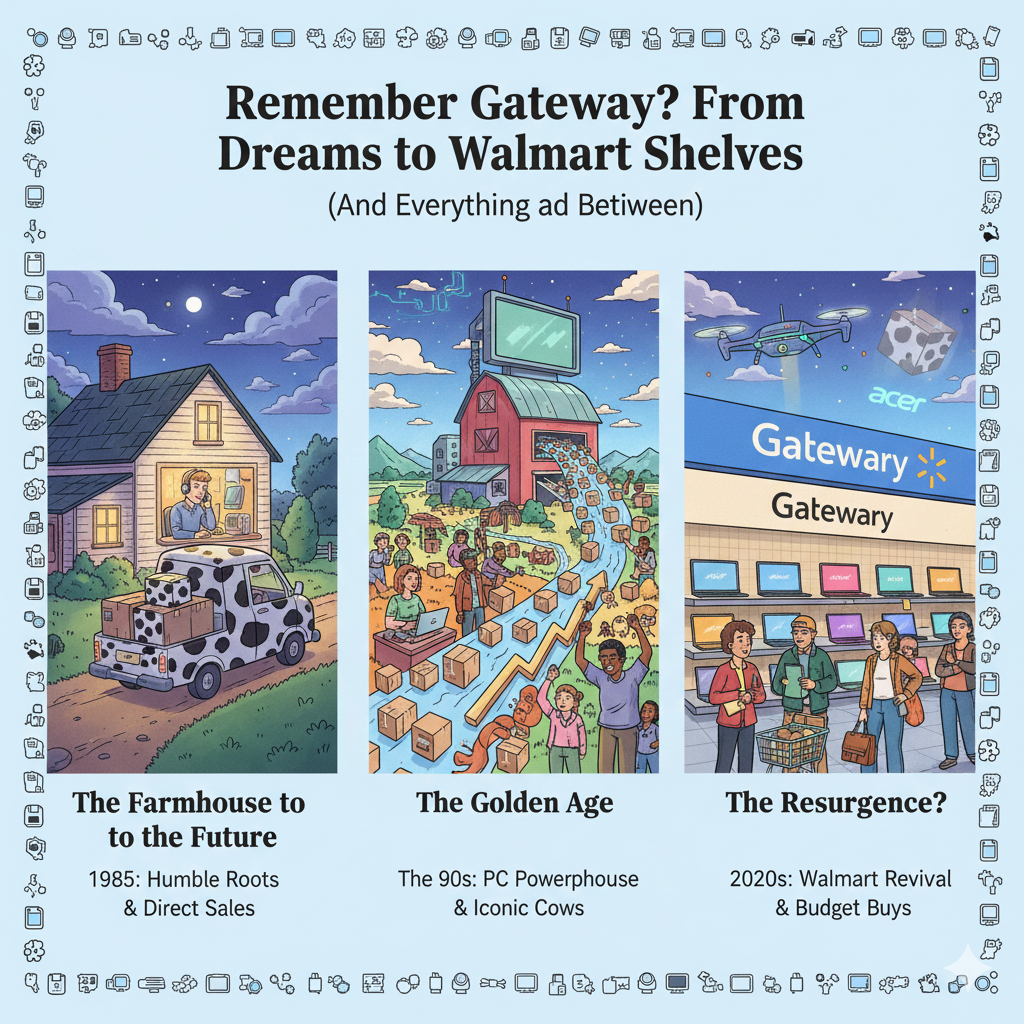
Ah, the late 20th century. A time of dial-up modems, CD-ROM drives, and those utterly distinctive, cow-spotted boxes. For many of us, that monochrome bovine print wasn’t just packaging; it was the herald of a new digital era, delivering our first truly powerful personal computer. We’re embarking on a journey today, a dive into the annals of tech history to revisit Gateway Computers – once a titan of the PC world, known for its unique branding and disruptive direct sales model. Its trajectory describes an incredible ascent, an iconic peak, and then a surprising series of twists and turns that led to its eventual, well, moo-vement out of the spotlight… only to resurface in an utterly unexpected fashion. A curious case study, indeed.
From the Farmhouse to the Future (of Computing): Gateway’s Origin Story
One must appreciate the almost pastoral beginning. Picture it: 1985. Not Silicon Valley, not a bustling metropolis, but a farmhouse in Sioux City, Iowa. Here, Ted Waitt and Mike Hammond ignited what was initially called “TIPC Network,” later known to the world as Gateway 2000. It was, one might argue, a quintessential American startup story – humble roots giving rise to grand ambitions.
Their genius lay not just in the hardware, but in their business model. They disrupted the nascent PC market with a bold direct-to-consumer approach. Bypassing the traditional retail middlemen allowed them to offer highly customizable PCs at fiercely competitive prices. This was revolutionary, empowering consumers to configure their machines precisely to their needs without inflated markups. And then, the icon was born: those now-legendary cow-spotted boxes. A quirky nod to their Iowa heritage, yes, but also a brilliant stroke of marketing that instantly distinguished them from the sea of boring beige boxes. It was a brand statement that resonated profoundly.
The Golden Age of Bovine-Themed Computing: Gateway at its Peak
Throughout the 1990s, Gateway wasn’t just a name; it was the name for many PC enthusiasts and home users. Its growth was nothing short of meteoric, often registering 20-30% quarter-over-quarter. They were, it seemed, everywhere. By 1999, their influence was undeniable, commanding nearly 10% of the U.S. PC market. One might posit that this level of market penetration speaks volumes about their brand loyalty and the effectiveness of their direct sales model.
This wasn’t merely a quirky startup anymore. By 2000, Gateway boasted almost 25,000 employees worldwide, a true global player. They offered a comprehensive buffet of computing solutions: desktops, servers, and an array of peripherals. It was a testament to their ambition and capacity, a company that had truly arrived on the global stage.
The Great Stampede Out of the Spotlight: What Went Wrong?
Such meteoric ascents often contain the seeds of future challenges, a curious paradox of success. For Gateway, the cracks began to show.
One of the most significant issues was the erosion of quality control. As rapid expansion continued, reports of product issues, shipping headaches, and inconsistent assembly began to proliferate. Customer service, once a cherished strength and a hallmark of their direct model, started to falter. For a brand built on trust and customization, this was an udderly devastating blow to their loyal customer base.
Furthermore, it’s fascinating to observe a strategic misstep that proved particularly costly: their slow adaptation to the burgeoning laptop market. While competitors were investing heavily in portable technology, Gateway remained largely focused on desktops. This was a critical misjudgment, as laptops were clearly the future, and their reluctance to pivot left a significant void.
Then came the classic cautionary tale of diversification disaster. Attempting to venture into consumer electronics – televisions, for instance – proved a costly distraction. Poor profits in these new ventures and the diversion of precious resources meant they lost focus on their core PC business, diluting their strength and market position.
An identity crisis was also brewing. As the PC market became increasingly crowded and commoditized, Gateway struggled to articulate a new Unique Selling Proposition beyond their original direct-sales model. Their supply chain, once an advantage, wasn’t cutting it in a more cutthroat environment. This loss of distinctiveness left them vulnerable.
Internally, instability reigned. A revolving door of CEOs and what some observers might characterize as “schizophrenic” business strategies meant there was no consistent vision. When the market turns tough, a lack of cohesive leadership and strategy is often a killer blow. Add to this the immense pressure from increased global competition and a general downturn in the PC market in the early 2000s, and the perfect storm was brewing.
The Resurgence? Gateway on the Modern Farm (and in Walmart)
For many, the story of Gateway seemingly concluded in 2007 when Acer, another global tech giant, stepped in and acquired the brand. The name lingered for a bit, then slowly faded, leading most to believe that was the final chapter in the cow-spotted saga.
Yet, like a phoenix – or perhaps a Holstein – rising from the ashes, a surprising plot twist emerged in 2020. BAM! New Gateway laptops and tablets suddenly appeared on Walmart shelves. It was a moment of nostalgic recognition for many, a testament to the enduring power of brand equity.
But what is modern-day Gateway? It’s crucial to understand that this isn’t the same Iowa farm gang. These are licensed products, manufactured by a third party for Walmart, firmly positioning them in the budget-friendly category. The aim is to capture the everyday consumer looking for an affordable computing solution. Current opinions, predictably, often laud their accessibility and price point, while also acknowledging compromises in quality and support compared to today’s major players like Dell, HP, or Lenovo. It is, undoubtedly, a different beast than the original.
“Pasture” Perfect Conclusion: What Gateway Taught Us
The journey of Gateway Computers is a remarkable narrative arc: from an Iowa farmhouse to a PC giant, through struggles to adapt and innovate, to its unexpected modern-day resurrection. It’s a rich tapestry of entrepreneurial spirit, market disruption, and the relentless forces of technological evolution.
Gateway’s legacy is, in many ways, a masterclass. It championed the power of distinctive branding, pioneered the direct-to-consumer model, and demonstrated the impact of genuine innovation. But it also serves as a potent cautionary tale. It underscores the critical importance of continuous innovation, the necessity of adapting swiftly to market shifts (especially in a volatile industry like tech), and the paramount need to maintain unwavering quality and customer trust, even amidst explosive growth.
Whether you fondly miss those iconic cow-spotted boxes or are simply discovering the brand through its modern iteration, the Gateway story reminds us that in the world of technology, nothing stays the same forever. Yet, sometimes, even the classics get a second act.
Did you own a Gateway PC? What’s your most cherished memory of those cow-spotted machines? Share your thoughts in the comments below!