Your Digital Sherlock: Tracing the Evolution of Web Search from AOL to AI
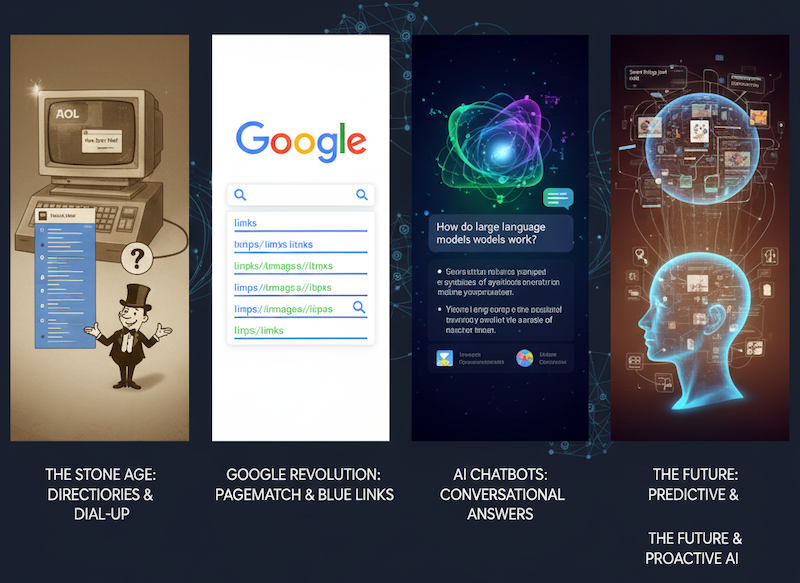
Cast your mind back, if you will, to an almost forgotten epoch – a digital era where the very act of seeking information online felt less like a quest and more like an archaeological dig, often culminating in the screech of a dial-up modem. The agonizing wait for a webpage to materialize, pixel by painstaking pixel, was merely the overture to the even more agonizing process of finding anything remotely useful amidst the nascent chaos of the internet. Oh, how far we’ve journeyed since those quaint, clunky days!
The way we unearth knowledge, conduct research, or simply satisfy a sudden curiosity online has undergone a transformation so profound, it truly beggars belief. We’ve moved from rudimentary, human-curated lists to the sophisticated, super-smart artificial intelligences now at our fingertips. This isn’t just another incremental tech story; it’s a revolution – a fundamental shift in how we learn, work, and interact with the sprawling digital tapestry. And here’s the spoiler alert for those still lingering in the shadows of “AI slop” headlines: AI isn’t just the next step; it’s a quantum leap forward, fundamentally reshaping our relationship with information itself.
The Stone Age of Surfing: When Browsing Was a Chore
Imagine, if you can, trying to find a needle in a haystack… if that haystack were organized by a slightly confused librarian whose only indexing system was a series of cardboard boxes labeled “Stuff” and “More Stuff.” That, my friends, was the early web searching experience in a nutshell.
In those halcyon days of “Welcome, You’ve Got Mail!”, the internet felt less like a global library and more like an untamed frontier. There were no magic algorithms to guide us; instead, we relied on human-curated directories. AOL, for instance, was largely a walled garden, offering pathways to content its editors deemed relevant. Then came the Yahoo! Directories, a valiant effort to impose order on the burgeoning chaos. Think of it as the Yellow Pages for the internet – you had to know which category your “needle” was likely hiding in, and then you’d manually sift through a hierarchical list of links. It was organized, yes, but hardly intuitive for dynamic exploration.
And who could forget Ask Jeeves? Our digital butler, bless its valiant, pixelated heart, attempted to understand our questions in natural language. It was, in a sense, the OG chatbot, a polite precursor to today’s AI. But alas, Jeeves, for all its charm, mostly just returned a list of links, albeit slightly better filtered ones. Lycos and Infoseek also played their part as early pioneers, yet their limitations underscored the monumental challenge of indexing a rapidly expanding, unconstrained digital universe. It’s almost amusing, looking back, at the sheer effort we once poured into what now takes a fraction of a second.
The Google Revolution: PageRank Changed Everything
Then, seemingly out of nowhere, in 1998, a certain company with a rather whimsical name arrived on the scene and, without much fanfare, turned the entire digital world on its head. That company, of course, was Google. And its secret sauce? PageRank.
Before Google, search engines primarily relied on keyword matching. If your query contained “quantum physics,” the engine would dutifully return pages that also contained “quantum physics.” Simple, yet often irrelevant. Google, however, introduced a profound insight: it wasn’t just about keywords anymore. PageRank viewed links between websites as “votes” – a hyperlink from one site to another was akin to an endorsement of its authority and relevance. The more quality “votes” a webpage received, the higher it ranked. Pure genius!
Suddenly, search results weren’t just lists; they were ranked by perceived authority and relevance. The most pertinent information magically appeared at the top of the list. What a concept! This paradigm shift didn’t just make searching easier; it birthed an entire industry known as Search Engine Optimization (SEO). Everyone, from garage startups to multinational corporations, suddenly understood the imperative of being on that coveted first page of Google results. For decades, “Googling it” became synonymous with typing in keywords and scrolling through a list of blue links – a digital comfort zone we all came to inhabit.
Enter the AI Chatbot: Talking Your Way to Answers
Just when we thought we had the very definition of “search” firmly etched in our digital psyche, along came ChatGPT, Gemini, and their formidable AI brethren. They arrived not with a whimper, but with a declarative, “Hold my beer… I mean, my data!”
This new wave of AI didn’t just break the mold; it shattered it. We’re no longer confined to the often-frustrating dance of guessing the right keywords. Instead, we can ask full, complex questions, just as we would engage in a conversation with a super-smart human expert. The profound shift here is from “finding” information by sifting through a deluge of links to “getting” direct, synthesized answers. It’s like having a personal research assistant who not only finds the relevant books but reads them for you and provides a concise summary.
While traditional keyword-based search engines still handle an immense volume of traffic daily, the meteoric rise of AI chatbot usage is simply staggering. We’re talking about year-over-year increases upwards of 80% for some of these platforms. The writing is not just on the digital wall; it’s practically glowing in neon: a new era of information retrieval has dawned.
Debunking the “AI Slop” Myth (and Celebrating the Serious Superpowers!)
Now, let’s address the proverbial elephant (or perhaps, the slightly amorphous blob) in the digital room: “AI slop.” Yes, we’ve all encountered it. Sometimes AI can generate generic, inaccurate, or just downright weird information – what the industry sometimes calls “hallucinations.” It’s a valid concern, especially with early models, or when the technology is improperly used or poorly prompted.
However, as an intellectual exercise, we must guard against the temptation to throw the digital baby out with the bathwater! To dismiss the profound benefits of advanced AI due to these teething problems would be a critical oversight. The sheer power and potential of this technology far outweigh these transient growing pains, especially as the models continue to mature at an astonishing pace.
Consider Benefit 1: Time Saved is Sanity Saved. This is, quite frankly, an enormous advantage. Instead of laboriously clicking through a dozen links, reading disparate articles, and then attempting to synthesize the information yourself, AI can deliver concise summaries or direct answers instantly. Think of the countless hours we’ve collectively spent scrolling, navigating ads, and parsing through irrelevant content. AI, when functioning optimally, offers the full report delivered directly to your desk, bypassing the arduous journey to the library, the search for the right books, and the task of writing the report yourself. This efficiency dividend is a game-changer for productivity and cognitive load.
Then there’s Benefit 2: Accuracy & Contextual Understanding (When Done Right). The best AI models aren’t merely matching keywords; they strive to understand your intent and the nuance of your question. When these models are connected to real-time web data and sophisticated knowledge graphs, they gain the capacity to fact-check, cross-reference, and provide up-to-the-minute, verified information. Far from creating “slop,” this capability actively combats misinformation by distilling credible sources. It’s about sophisticated reasoning, not just pattern matching.
Finally, Benefit 3: Personalization & Accessibility. Advanced AI has the unique ability to tailor information to you – your learning style, your existing knowledge, your preferred level of detail. It can simplify complex topics, explain jargon, and even translate information into different languages, thereby democratizing knowledge and making it profoundly more accessible to everyone, regardless of their background or expertise. These are not minor improvements; they are societal accelerators.
The Future is Conversational (and Maybe Mind-Reading!)
The lines between a traditional search engine and an intelligent AI assistant are not merely blurring; they are rapidly dissolving into an integrated, seamless experience.
We’re already seeing the advent of integrated AI search, where platforms like Google are weaving generative AI deeply into their core search functionalities. Your “results” won’t just be a list of links; they will be interactive conversations, synthesized insights, and personalized responses that evolve with your queries. The static page is giving way to a dynamic dialogue.
Imagine, further, the promise of proactive & predictive information. An AI that learns your habits, preferences, and contextual needs, delivering relevant information before you even consciously realize you need to ask for it. “Your smart fridge just ordered milk, and here’s a recipe for that leftover spinach you’ve got.” Or, “Based on your recent travel plans, here are the top-rated restaurants in Rome, along with real-time flight delay updates for your connecting flight.” This is the truly exciting frontier – an AI that anticipates, rather than merely reacts.
And finally, the magic of multimodal interaction. The future of search won’t be confined to text boxes. You’ll talk to your search engine, show it a picture of something you’re trying to identify, describe a video clip to find its source, or even hum a tune to identify a song. Interaction will become as natural and intuitive as human communication itself, seamlessly bridging all forms of media.
From Humble Beginnings to a Smarter Tomorrow
Our journey has been nothing short of extraordinary. We’ve traversed the digital landscape from the clunky, manually curated directories of early AOL and Yahoo! to the sophisticated, conversationally intelligent AI systems of today. What a ride it has been!
This isn’t merely an upgrade; it’s a fundamental shift, transforming information access into something faster, smarter, and profoundly more intuitive. While the internet, like all living organisms, continues its relentless evolution, one thing becomes crystal clear: the quest for knowledge is no longer a solitary expedition through static pages. It is rapidly becoming a dynamic, intelligent dialogue. And the future of finding information, which looks a lot like having a genuinely helpful conversation, is truly something to be profoundly excited about. Our digital Sherlock is getting smarter, more proactive, and more deeply integrated into the fabric of our lives, promising an age of unprecedented informational fluency.